
Registrations have closed.
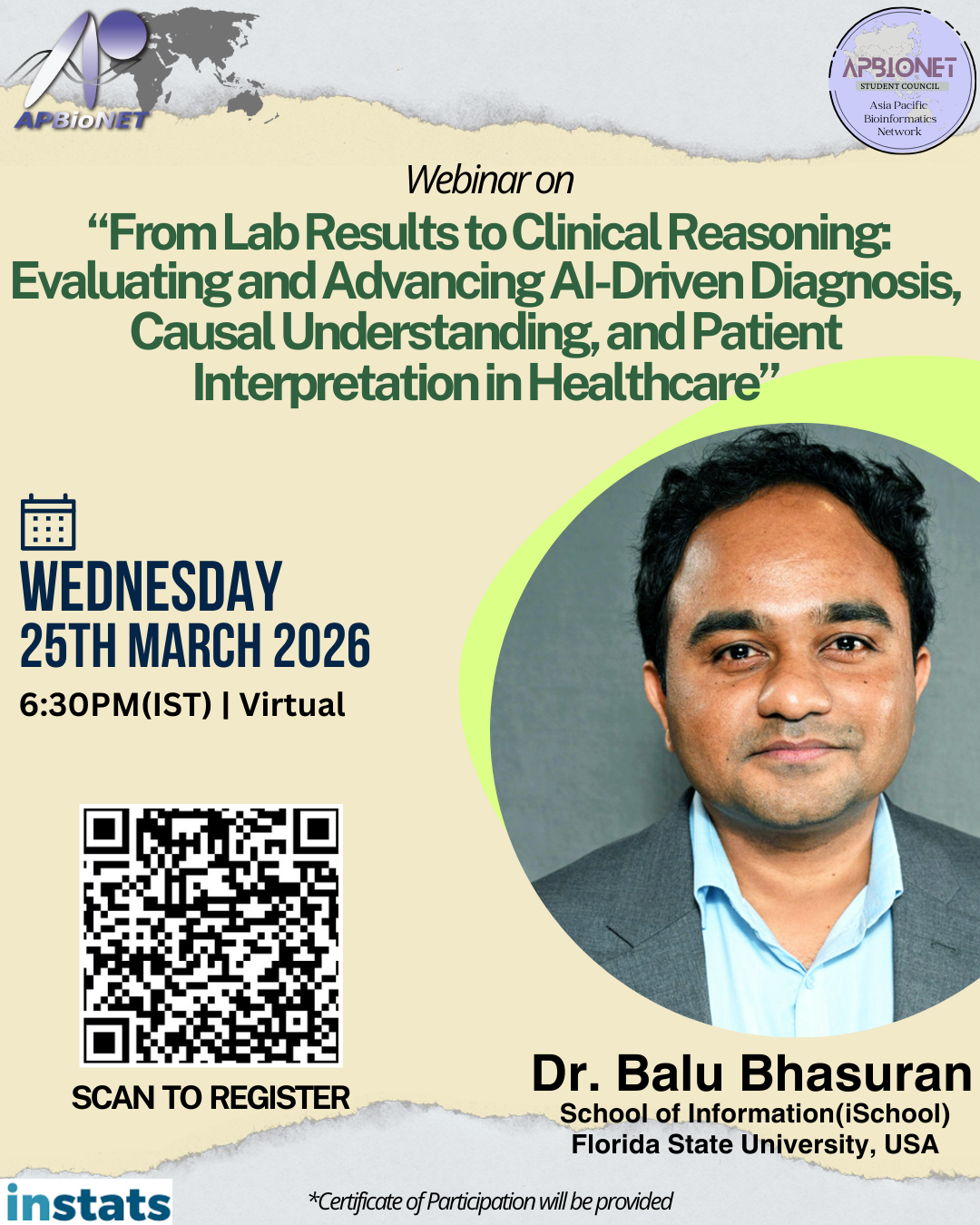
AI for Clinical Reasoning and Diagnosis (APBioNet Talks)
70 70 people viewed this event.
This seminar examines AI-driven clinical reasoning at the intersection of laboratory results, EHRs, LLMs, and causal inference. Participants explore how clinical data can be integrated with language models to support diagnostic hypotheses and patient-facing explanations, while meeting the epistemic demands of clinical research, including reproducibility, temporality, and domain shift.
Methodologically, the seminar focuses on causal graphs and counterfactual evaluation of LLM outputs, alongside temporal alignment of lab trajectories and clinically informed evaluation metrics that go beyond aggregate accuracy. Practical guidance is provided on building reproducible pipelines that combine structured lab values, free-text notes, and constrained generation to improve clinical plausibility and mitigate hallucination.
Designed for PhD students and academic researchers, the seminar targets publishable, methodologically rigorous research with translational impact, balancing conceptual depth with implementation insight. Participants leave with actionable evaluation strategies, reproducible patterns, and a clear research agenda for AI-driven clinical decision support.
By the end of the seminar, participants will be able to …
-
Describe best practices for extracting and normalizing laboratory test results from EHRs for downstream modeling.
-
Construct causal directed acyclic graphs that represent diagnostic reasoning with time-indexed clinical events.
-
Design counterfactual evaluation protocols that test causal claims of AI-driven diagnoses.
-
Implement prompt engineering and constrained generation techniques tailored to clinical plausibility.
-
Measure and report calibration, discrimination, and subgroup robustness for lab-informed models.
-
Integrate structured lab features with LLM-derived text representations in reproducible pipelines.
-
Apply sensitivity analyses for missingness, measurement error, and temporal misalignment in EHR data.
-
Develop explanation fidelity metrics that link model outputs to clinically meaningful rationales.
-
Prepare experimental designs and documentation suitable for submission to ML, informatics, or clinical journals.
-
Evaluate human-AI interaction considerations for patient-facing lab result interpretations.
-
Assess ethical and safety trade-offs when deploying LLM-supported decision aids in clinical contexts.
-
Translate pilot analyses into actionable research plans and grant or manuscript outlines.